
The Ultimate Ui Ux Design Roadmap for Aspiring Professionals

Written by: Haidersafi

Facts checked by: Haidersafi


Founded in 2025, FusioPoint is a global web design and mobile app development agency, trusted for delivering innovative and secure digital solutions.
Starting a career in Ui Ux Design doesn’t require a traditional degree—it demands a structured, intentional learning path. By mastering visual principles first, deeply understanding user experience research, and building a strong portfolio of real-world case studies, anyone can transition into product design efficiently. Here is your actionable, step-by-step guide to achieving professional eliteness.
What I Would Do Differently: Lessons from a Self-Taught Designer
The journey to becoming a fully self-taught Product Designer is filled with trial and error. If I were to start over, I would optimize my learning curve by avoiding isolation and focusing on structural growth.
- Seek Active Mentorship: The ocean of product design is vast. A mentor can help you filter the noise, speeding up your grasp of complex concepts.
- Embrace Collaboration: You will never work alone in a professional agency or tech environment. Join communities, partner with developers, and build products together.
- Participate in Rigorous Challenges: Move beyond basic daily prompts. Engage in competitive design challenges that require deep problem-solving and yield high-quality feedback.
Step 1: The Pre-Practice Phase
Before opening any software, you must understand the foundational theory. Grab a pen and paper and clearly define the differences and overlaps between User Interface Design, User Experience Design, and general Product Design.
Start with short, foundational courses (like those from Career Foundry or Google) to test the waters. If the underlying psychology and visual problem-solving excite you, you are ready to commit.
Step 2: Master User Interface (UI) Design First
While controversial, starting with UI design offers a distinct advantage. Aesthetics are what recruiters and users notice first. The principles guiding color, typography, visual hierarchy, and layout are universal and provide immediate, satisfying feedback as you learn.
Train Your Eye and Learn Your Tools
Soak your mind in good design by studying high-quality interfaces before you try to create them. Once your eye is trained, it’s time to pick up your wand: Figma.
Figma is the undisputed industry standard for professional collaboration, prototyping, and developer handoff. To master it rapidly, practice copy work—tracing excellent mobile and web screens pixel-for-pixel. This forces you to understand spacing, scale, and layout choices in real-world applications.
Step 3: Dive Deep into User Experience (UX) Design
“People ignore design that ignores people.” — Frank Chimero
A beautiful interface brings users in, but a seamless experience keeps them. UX design is the analytical backbone of your work.
You must learn to empathize with the user and align their needs with business goals. This involves mastering the Design Thinking Process, conducting user research, and utilizing tools like User Personas and Empathy Maps. The Google UX Design Course on Coursera is an excellent, rigorous starting point, but always supplement your learning with articles from the Nielsen Norman Group (NN/g) and Smashing Magazine to avoid getting locked into a single methodology.
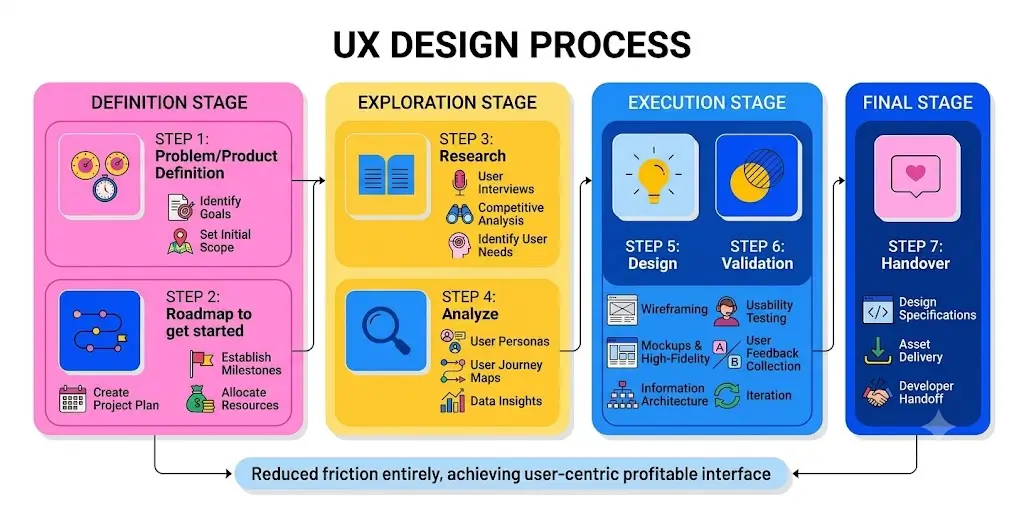
Watch this breakdown of how these distinct phases interact during the lifecycle of a real project:
Key insight: The strongest products emerge when high-fidelity UI creation and usability testing inform each other in a continuous loop, rather than acting as isolated steps.
Step 4: Build Case Studies and a Professional Portfolio
Your portfolio is your ultimate currency. When assembling your case studies, you must articulate the “why” behind your pixels.
A strong case study should clearly document your UX process (the problem and your research), your UI decisions (how you visually solved the problem), and the final impact. Publish your work openly to gather constructive feedback and demonstrate your capabilities to potential employers.
Step 5: Continuous Growth in Product Design
The digital landscape evolves rapidly. To maintain your edge, you must commit to continuous improvement. Read seminal books like The Design of Everyday Things, listen to industry podcasts, and stay curious. Mastery in Ui Ux Design is not a destination; it is a continuous, rewarding practice.
In this article
- What I Would Do Differently: Lessons from a Self-Taught Designer
- Step 1: The Pre-Practice Phase
- Step 2: Master User Interface (UI) Design First
- Step 3: Dive Deep into User Experience (UX) Design
- Step 4: Build Case Studies and a Professional Portfolio
- Step 5: Continuous Growth in Product Design
Web Design, Development

Haidersafi
Haider Safi is a senior content writer who excels at making complex tech ideas simple and engaging. He's a strategic storyteller for the digital world, giving a clear voice to breakthrough concepts. Outside of writing, you'll find him diving into a great book or tracking the next big trend.